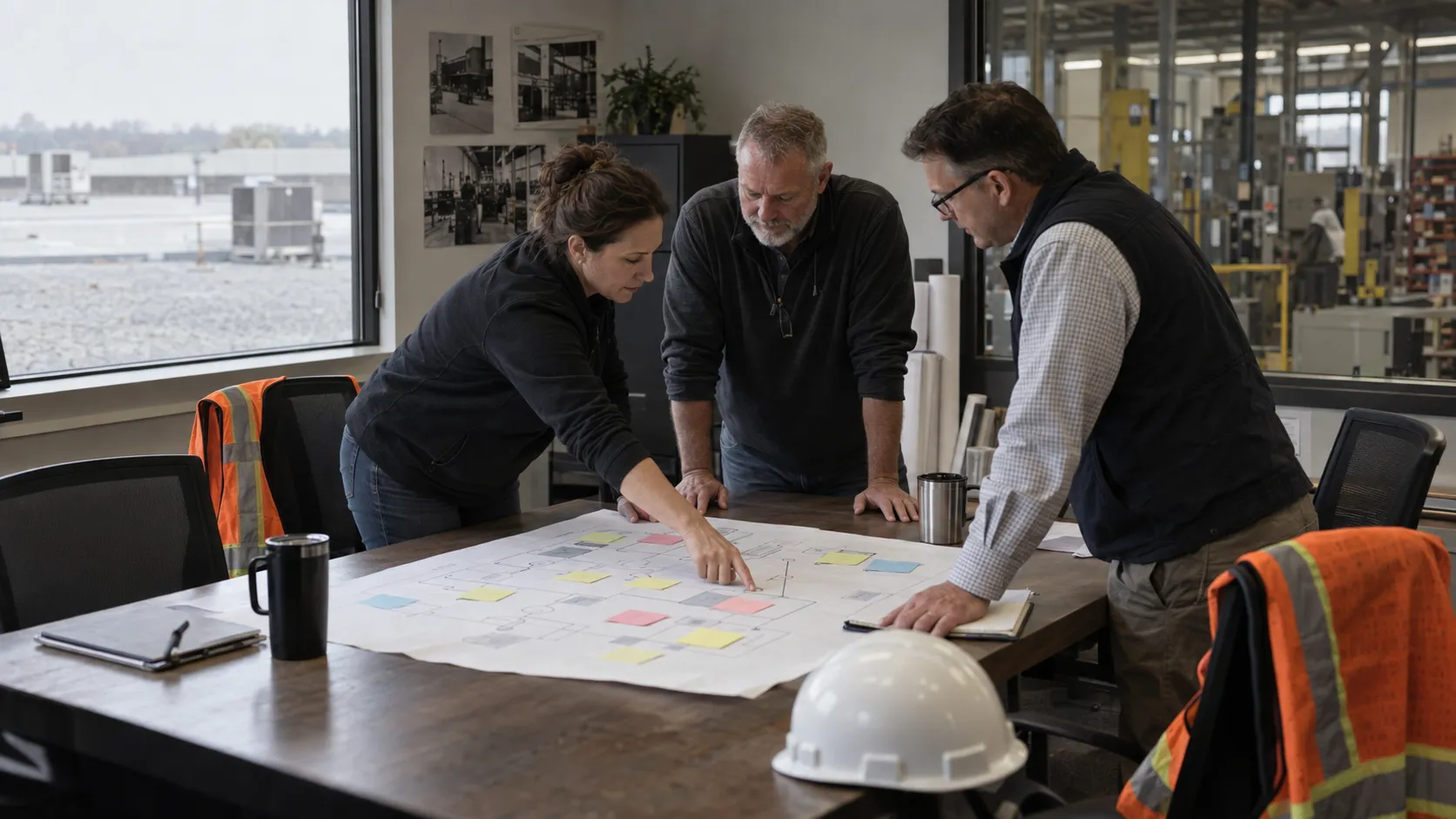
How we build AI with your team.
Software is half the job. We build the AI, and we train your people to check its work and manage it. This page shows every step and every meeting.
The four steps, from diagnostic to daily use.
Four steps across three phases. A 4-6 week diagnostic finds where AI pays off first. The first build takes 90 days after that, and rollout to your other sites follows. You decide whether to continue after each phase.
Diagnose
- Interviews on the floor
- Map of where work stalls
- Business case, tested on 50 past jobs
Build
- Connected to your email and files
- Taught on 50-200 of your past jobs
- Two weeks drafting, nothing sent
Go live
- Live once it clears your written bar
- A person approves every draft
- Reviewers trained on their own jobs
Operate
- Weekly scorecard, monthly review
- Next system, same job record
- Quarterly roadmap with leadership
How we prepare your people and the AI.
82% of manufacturers cite a lack of AI-ready skills as their top AI workforce challenge (NAM and MLC, 2025). Training your people is in our scope from day one.
Leaders set the rules
The owner and department heads pick the first AI role, name the person who manages it, and decide what it may do without a signature.
Each AI role gets a manager
An AI employee is AI software set up like a new hire: its own login and one defined job. Each one gets a named manager and a written list of what it may do alone and what needs a signature.
We give it your examples
We give it your SOPs, your parts list, and 50 to 200 real past examples in files it reads every time it works. Then it spends two weeks in shadow mode: it drafts on live work, nothing is sent, and your team compares its drafts with their own.
We test it before go-live
Before building, we set aside 50 past cases with known answers, and the AI never sees them while we build. It goes live only after it clears the bar you wrote down: an accuracy score on those cases and zero critical errors, such as a wrong heat number. After that, a person approves every output.
Every meeting, listed before we start.
Five meetings, each with a set length and a set group. None of them grows into a standing committee.
Owner and department heads. Pick the first AI role, set the approval rules, agree on the scorecard.
The department that owns the role. Map the workflow step by step, choose and set aside the 50 test cases, and start collecting examples.
The AI employee's manager and our builder. Walk the scorecard: drafts accepted, corrected, and rejected, and time per task.
Owner and department heads. Results against the business case and the next role to add.
Leadership and each AI employee's manager. Pick the next roles and decide which new AI models to test on your 50 test cases.
days from kickoff to a system your team uses every day.
The first build covers one job in one department, with one named manager. Every checkpoint has a written go or stop decision, and stopping early with a clear reason counts as a result.
The three phases of working with us.
For custom and high-mix manufacturers with 200 or more people, and for groups running several plants.
Diagnostic
A plan for where AI pays off first, tested on 50 of your real past jobs.
- On-site with your leadership
- Map of where work stalls
- Business case and roadmap
First build
Most start hereWe build the system your company needs and put it in daily use, with your team trained to run it.
- Uses Trace (cert packets), Quote (quoting), Operators (shared inbox), or Command (job record), as your work needs
- Connected to your ERP, inbox, and files
- Leadership meetings and reviewer training
Rollout
The same system at every plant, run with your leadership.
- One record across all sites
- New models tested on your cases first
- Monthly results, quarterly plan
Questions we hear
What is a Movement Global diagnostic, and how long does it take?
The diagnostic is a fixed-fee engagement that takes 4 to 6 weeks. We work on-site with your leadership, interview the people who do the work, map where jobs stall, and test the first use case on 50 of your real past jobs. You get a business case and a roadmap for where AI pays off first, and the plan is yours to keep.
How are Movement Global engagements priced?
There are three steps: a fixed-fee diagnostic, a fixed-scope first build that takes 90 days, and a rollout to your other sites, priced in the first contract. The diagnostic fee is credited to your first build. You decide whether to continue after each step, and the diagnostic shows the cost and the expected payoff before any build starts.
How do we know the AI is good enough to go live?
Before anything is built, your team sets aside 50 past cases with known answers and writes down the bar: an accuracy score on those cases and zero critical errors, such as a wrong heat number or PO. The AI goes live only after it clears that bar and two weeks of drafting on live work with nothing sent. After that, a person approves every output and a weekly scorecard counts drafts accepted, corrected, and rejected. Chapter 4 of the free AI Employee Handbook shows how to set this up yourself.
Who owns our data when we work with Movement Global?
Your data stays in your own systems and accounts, with permissions you set. Movement Global keeps a written record of every AI action, and the diagnostic plan is yours to keep.
Do we need to be technical to work with Movement Global?
No. You need to know your business, because deciding what the AI should do and who reviews its work is a management decision. Movement Global does the technical work of connecting systems and building approval rules, and training your team is in scope from day one.
What happens to our people's jobs?
AI takes the retyping, the copying between systems, and the sorting. The people who did that work review the drafts, handle the exceptions, and sign, the same as today. Staffing decisions stay with you. We help you tell your team plainly what changes, who reviews what, and where the hours go.
What size and type of manufacturer is Movement Global for?
Movement Global works with manufacturers and industrial companies that have 200 or more people, including groups with several plants and private-equity-backed platforms. Typical fits include metals and fabrication, oil and gas equipment and flow lines, circuit board assembly, signage, building products, machining, and industrial equipment.
See where your team's hours go.
Free, about 3 minutes. It estimates the hours your team spends retyping, and your report shows on screen.