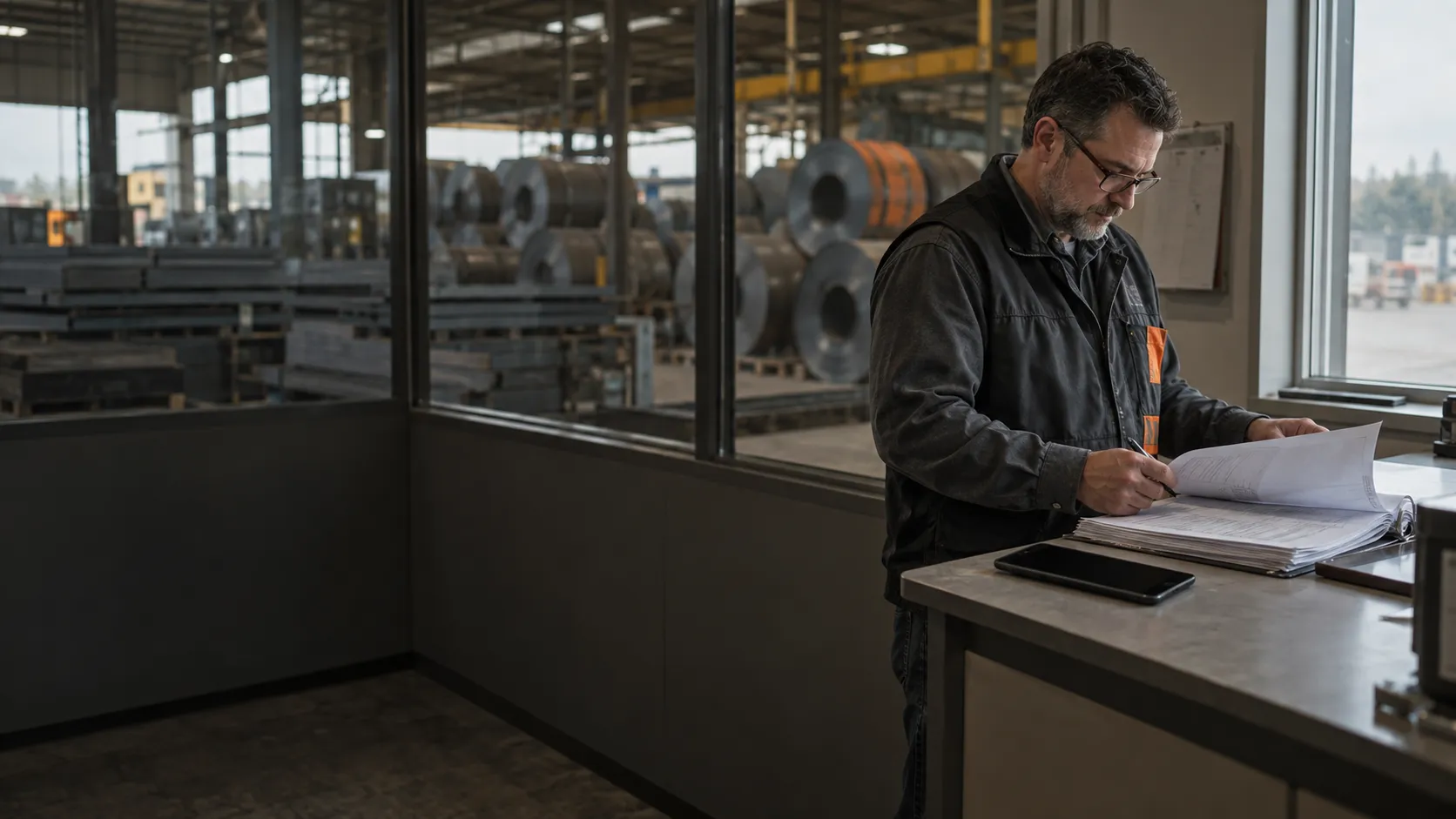
Trace builds and checks your cert packets.
Trace is an AI system for manufacturers whose customers want a cert packet with each shipment. It reads the MTRs, the PO, and the customer spec, checks every heat against its PO line, and builds the packet. Your quality team checks what it flags and signs.
The scan takes about 3 minutes and estimates the office hours AI could take on. Your report shows on screen.
Packets built by hand are slow, and one missed mismatch can reject a shipment.
Mills send MTRs as scans, PDFs, and email attachments, each in its own layout. Today someone in quality reads each one, matches heats to PO lines, checks grade and chemistry against the spec, and builds the packet by hand.
Trace does
- Pulls MTRs, CoCs, and CoOs from email and shared drives
- Checks heat, grade, chemistry, mechanicals, quantity, and origin against the PO and spec
- Builds one PDF packet, every value linked to the page it came from
Your people do
- Check each flagged mismatch against the source page
- Approve and sign the packet
- Decide what happens to a heat that fails
Material certification
| Line | Heat | Grade | |
|---|---|---|---|
| 1 | 4B2291 | A572 Gr 50 | ✓ |
| 2 | 4B2291 | A572 Gr 50 | ✓ |
| 3 | 7C0418 | A572 Gr 50 | ✓ |
| 4 | 9A1156 | A36 | ! |
Example screen.
MTRs, CoCs, CoOs, POs, customer specs, packing lists
Read access to the inbox and drives where certs land, your packet template, and 50 to 200 past packets
Sign a cert, correct a mill's numbers, or send anything to a customer
Questions we hear
What is an automated MTR, CoC, and CoO packet?
It is the cert packet your customer asks for, assembled and checked by software instead of built by hand. Trace collects the MTRs and certs, matches them to the shipment, and produces one PDF with the MTRs, CoCs, and CoOs. Your quality team reviews what it flags.
How does Trace check heat numbers against PO lines?
Trace matches each heat on an MTR to its PO line and the customer spec, checking heat, grade, chemistry, mechanicals, quantity, and origin. When a value does not match, such as a heat whose grade differs from what the PO calls for, Trace flags it for a person to check before the shipment goes out.
Does a person still sign the cert packet?
Yes. Trace assembles the packet and flags mismatches. Your quality team checks each flag, approves and signs the packet, and owns the commitment to the customer. Every value in the packet links to the page it came from, so checking a flag takes a click instead of a search through the file.
What does Trace need from us?
Read access to the inbox and drives where MTRs and certs arrive, your customer specs, your packet template, and 50 to 200 past orders with the packets your team built for them. Those past packets show Trace how your team does the job. It also needs one named person in quality who reviews its work.
How does Trace go live?
Only after it passes a test. Before any build, your team sets aside 50 past orders with known right answers, and nobody shows them to Trace. Trace then works those 50 cases, and we check its work field by field. Your executive sponsor and our team agree in writing on the accuracy it must reach, with zero critical errors (for example a wrong heat number on a packet). Then it runs in shadow mode (it drafts on live work for two weeks while nothing it makes is sent) before it goes live with a person approving every output. This all happens inside the first 90-day build.
Other systems we build
See where your team's hours go.
Free, about 3 minutes. It estimates the hours your team spends retyping, and your report shows on screen.